Kaivalya Depression Anxiety & Sex Clinic
+91-9266511325, +91-8709570126, +91-7764842043
Kaivalya Depression Anxiety & Sex Clinic
+91-9266511325, +91-8709570126, +91-7764842043
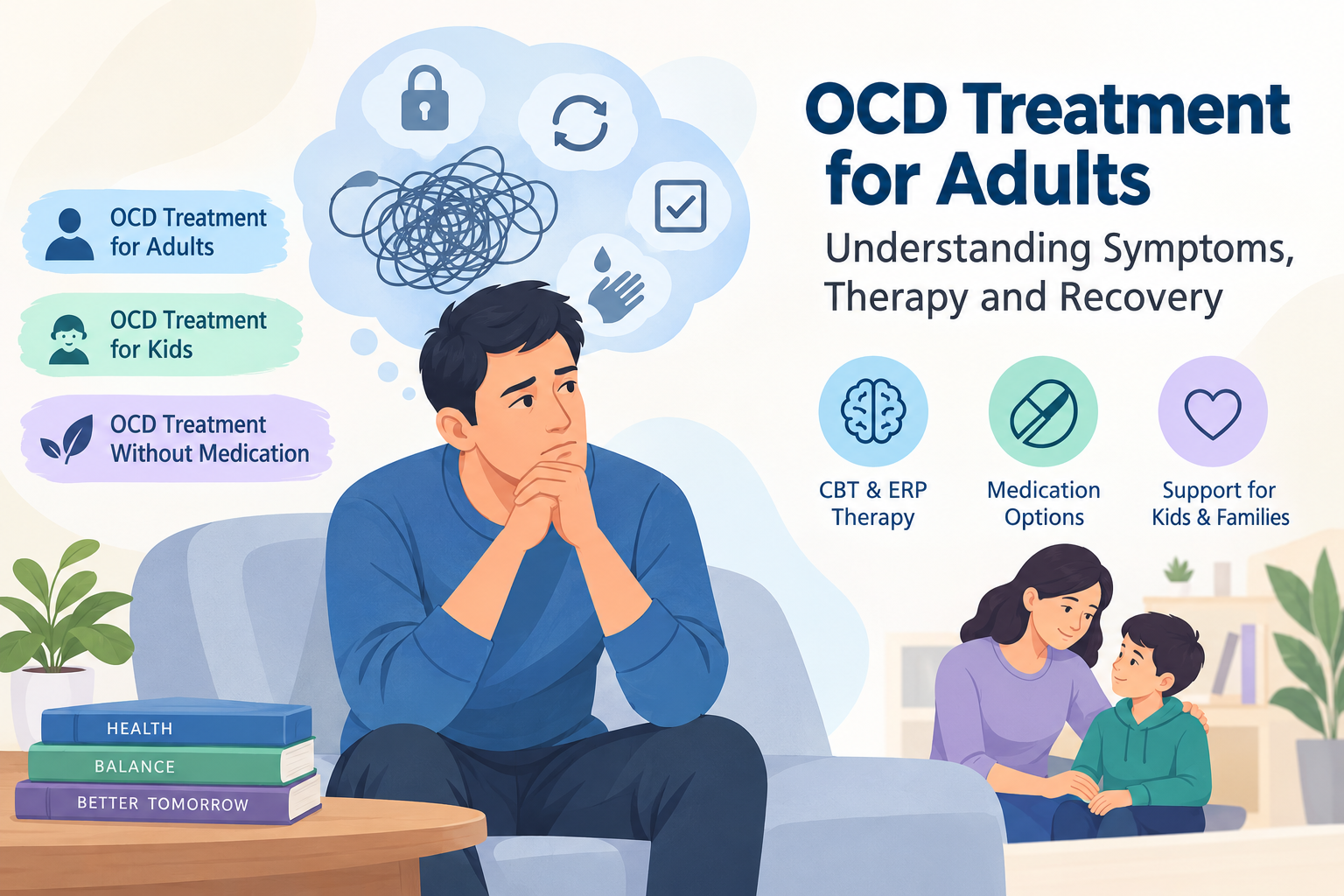
Obsessive-Compulsive Disorder (OCD) is a chronic and often debilitating psychiatric condition characterized by intrusive thoughts (obsessions) and repetitive behaviours or mental rituals (compulsions) . For adults living with OCD, the condition can interfere with work, relationships, and daily functioning. However, with the right treatment approach, significant improvement is possible.
This comprehensive guide explores evidence-based OCD treatment options for adults, along with insights into OCD treatment for kids and approaches for those seeking OCD treatment without medication. Whether you are exploring treatment for yourself or a loved one, understanding the available options is the first step toward recovery.
OCD is characterized by persistent, unwanted thoughts, images, or urges that cause marked distress or anxiety (obsessions), along with repetitive mental or behavioural acts that the individual feels driven to perform (compulsions) to reduce that distress.
Common obsessions include:
Common compulsions include:
For a diagnosis of OCD, these symptoms must be time-consuming (often more than one hour per day) or cause significant impairment in functioning.
The two most effective, evidence-based treatments for OCD in adults are Cognitive-Behavioural Therapy (CBT) — specifically Exposure and Response Prevention (ERP) — and medication (SSRIs or clomipramine). For many adults, a combination of both approaches provides the best outcomes, especially for moderate to severe symptoms.
ERP is considered the first-line psychotherapy for OCD and has the strongest evidence base. It is effective at all levels of symptom severity.
How ERP Works:
Key Points About ERP:
For adults who prefer medication, cannot access ERP, or have moderate to severe symptoms, Selective Serotonin Reuptake Inhibitors (SSRIs) are the preferred pharmacological treatment.
Common SSRIs for OCD include:
Important Notes:
Many adults are interested in OCD treatment without medication. ERP and CBT are highly effective standalone treatments. For mild to moderate OCD, psychological therapy alone can produce significant and lasting improvement.
Some patients also benefit from cognitive therapy (CT) , which targets maladaptive beliefs (e.g., inflated responsibility, intolerance of uncertainty). Contemporary research shows that when delivered using OCD-specific protocols, CT outcomes are comparable to ERP, with similar dropout rates and no evidence of symptom worsening.
OCD often begins in childhood or adolescence. If not effectively treated, it can persist into adulthood and cause substantial impairment.
Treatments with the strongest evidence for paediatric OCD include:
Key Takeaway: Early diagnosis and treatment of paediatric OCD is associated with better long-term outcomes. However, about 40% of cases persist into adulthood, so continued support may be needed.
For adults who do not achieve adequate relief from first-line treatments, several emerging options show promise.
Neuromodulation Techniques
TMS is a safe, non-invasive neuromodulation technique. It is FDA-approved for OCD in adults aged 18 and above.
Research is ongoing for use in children. A 2025 proof-of-concept study found that personalized TMS targeting the postcentral gyrus showed potential for reducing sensory-based urges in OCD.
A randomized, sham-controlled trial found that cathodal tDCS over the right orbitofrontal cortex enhanced inhibitory control in subclinical OCD, suggesting a novel therapeutic mechanism for compulsivity remediation.
A pilot study found that alpha-frequency tACS applied over the praecuneus was effective and safe for patients with OCD, with an 85.7% response rate at week 2.
Augmentation Strategies
For treatment-refractory OCD (where SSRIs alone are insufficient), augmentation with an atypical antipsychotic (e.g., aripiprazole, risperidone) has the most supporting data. Other options with some evidence include buspirone, memantine, and N-acetylcysteine.
Seeking help from a mental health professional with experience in treating OCD is crucial for accurate diagnosis and an effective treatment plan.
When looking for a provider, consider:
Kaivalya Neuro-Psychiatry and Diabetes Clinic in Janakpuri, New Delhi, offers professional, confidential, and personalized mental health treatment.
Their services include depression and anxiety treatment, panic disorder and OCD counselling and psychotherapy . They can provide compassionate care and evidence-based treatment from a leading mental health specialist.
Book an appointment: https://www.kaivalyaclinic.com/
Q1: What is the most effective treatment for OCD in adults?
The two most effective treatments are Cognitive-Behavioural Therapy (CBT) — specifically Exposure and Response Prevention (ERP) — and medication (SSRIs or clomipramine). For many adults, a combination of both provides the best outcomes, especially for moderate to severe OCD.
Q2: Can OCD be treated without medication?
Yes. ERP and CBT are highly effective standalone treatments. For mild to moderate OCD, psychological therapy alone can produce significant and lasting improvement. Some patients also benefit from cognitive therapy (CT), which shows outcomes comparable to ERP
Q3: How does ERP work for OCD?
ERP involves gradually exposing the person to situations that trigger their obsessions while preventing them from performing their compulsive rituals. Over time, the anxiety triggered by the obsession diminishes through habituation, and the person learns that rituals are unnecessary for reducing discomfort.
Q4: What is the best treatment for OCD in children?
For children and adolescents, CBT with ERP is the first-line behavioural treatment, often combined with SSRIs for moderate to severe symptoms. Family involvement is important to support the child and help manage rituals.
Q5: How long does OCD treatment take?
ERP typically involves 12-20 weekly sessions, though this varies by individual. Medication may take 8-12 weeks to become fully effective. Improvement is often gradual, and many individuals continue to practice ERP techniques after formal treatment ends.
Q6: What if first-line OCD treatment doesn't work?
For treatment-resistant OCD, options include augmentation with an atypical antipsychotic, trying a different SSRI, or exploring neuromodulation techniques like TMS or tDCS.
Q7: Is TMS approved for OCD?
Yes. Transcranial Magnetic Stimulation (TMS) is FDA-approved for OCD in adults aged 18 and above. Testing for use in children is in progress.
Q8: How do I find an OCD specialist?
Look for a mental health professional with specialized training in ERP and experience treating OCD. You can ask your primary care physician for a referral or contact a psychiatric clinic directly. Kaivalya Neuro-Psychiatry and Diabetes Clinic in Janakpuri, New Delhi, offers specialized OCD treatment.
Q9: Can OCD be cured?
OCD is often a chronic condition, but it is highly treatable. Many individuals experience significant improvement in symptoms with the right combination of therapies and support. Some may achieve remission, while others learn to manage symptoms effectively.
Q10: What should I expect during an OCD assessment?
An assessment typically involves a clinical interview about your symptoms, their severity, and how they affect your daily life. The Yale-Brown Obsessive-Compulsive Scale (Y-BOCS) may be used to grade severity and monitor progress.
OCD is a treatable condition, and most individuals can experience significant improvement with the right combination of therapies and support .
For adults, ERP and SSRIs remain the gold standard, with emerging neuromodulation techniques offering hope for treatment-resistant cases. For children, family-based CBT with ERP and SSRIs are the most evidence-supported approaches.
If you or a loved one is struggling with OCD, seek help from a mental health professional experienced in treating this condition. With proper diagnosis and an individualized treatment plan, recovery is possible.
Contact Kaivalya Neuro-Psychiatry and Diabetes Clinic to learn more about OCD treatment options and to schedule a consultation

If you are looking for premature ejaculation therapy in Dwarka, this comprehensive guide covers ever...
OCD is characterized by persistent, unwanted thoughts, images, or urges that cause marked distress o...
Looking for the Best Therapy for Relationship Problems? Get professional support through Marriage Co...